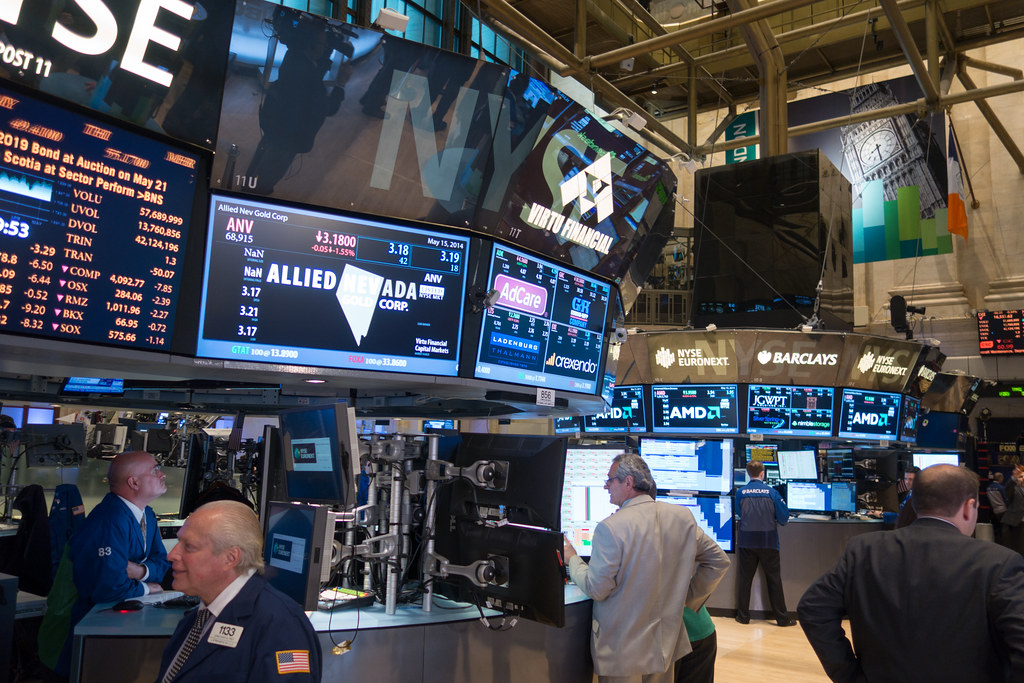
Wall Street steadied on Wednesday, with major indexes edging higher a day after a sharp technology-led selloff, as falling oil prices and receding Middle East risk gave investors room to buy back in. The S&P 500 rose about 0.4% and the Nasdaq Composite added roughly 0.6%, while the narrower, more tech-heavy declines of the prior session showed signs of stabilizing. The Dow Jones Industrial Average lagged, slipping around 0.2%.
The bounce followed Tuesday's rout, when concern over stretched artificial-intelligence valuations and a cautious note on the rate outlook hit semiconductors and megacap technology hardest. The small-cap Russell 2000 rose about 0.4% on Wednesday, a sign that the recovery was broadening beyond the largest names even as the megacaps that have driven the market all year remained the swing factor.
Crude oil was the session's clearest trend. West Texas Intermediate, the U.S. benchmark, slid again to settle near $70 a barrel — down from above $96 at the start of June — extending a steep decline driven by the de-escalation of the Iran conflict and the prospect that Gulf supply will not be disrupted. The drop in energy prices is a double-edged signal: a relief for inflation and consumers, but a drag on the energy shares that had buoyed indexes during the spring crisis.
Oil's retreat traces directly to the diplomatic track between Washington and Tehran. With a memorandum of understanding signed last week and no naval blockade of the Strait of Hormuz, the war-risk premium that pushed crude toward triple digits earlier in June has rapidly unwound. Each leg lower in oil has tended to coincide with a steadier equity tape, as the market reprices the odds of a supply shock away.
Investors were also positioning ahead of a closely watched earnings report from memory-chip maker Micron Technology, seen as a barometer for AI-driven demand for high-bandwidth memory. A strong outlook would reinforce the bull case that has powered semiconductors; a cautious one would feed the valuation worries that triggered Tuesday's drop. The result lands against a backdrop of a sector that has been priced for something close to perfection.
The cross-currents capture a market caught between two stories. On one side, cooling oil and a fading geopolitical crisis argue for lower inflation and a friendlier path for the Federal Reserve. On the other, the AI trade that accounts for an outsized share of this year's gains has grown sensitive to any hint that spending or returns might disappoint, making the tape prone to sharp, concentrated swings.
Tuesday's selloff was a reminder of that fragility. A single broker note questioning the rate path, combined with weakness out of Asia, was enough to send chip stocks tumbling — evidence of how much of the index's direction now rests on a handful of names whose valuations leave little margin for error.
For now, the combination of a deescalating war, falling energy costs and resilient breadth was enough to halt the slide. Whether it marks a durable floor or a pause depends in large part on the earnings and guidance still to come from the chipmakers at the center of the AI boom — and on whether oil's slide stabilizes or turns into a sign of softening global demand.